
Crawl Space Encapsulation in Hicksville
24/7 crawl space encapsulation in Hicksville and surrounding areas. IICRC-certified technicians, insurance billing accepted. Call (631) 831-1880.
What Crawl Space Encapsulation actually involves
Most Long Island homes built before the 1980s have vented crawl spaces that were never designed for the humidity levels we see on this part of Nassau County. Outside air carries moisture in through the vents, that moisture hits cooler ground and framing, and condensation forms on floor joists and subfloor sheathing. Over a few seasons, that cycle softens wood fiber, feeds wood-destroying fungi, and lets musty air drift up into living spaces through gaps around plumbing stacks and HVAC returns. If you’ve noticed a damp, earthy smell on the first floor, cupped hardwood near exterior walls, or a crawl space floor that’s always slightly wet even without a recent rain, you’re looking at a moisture management problem, not a one-time leak.
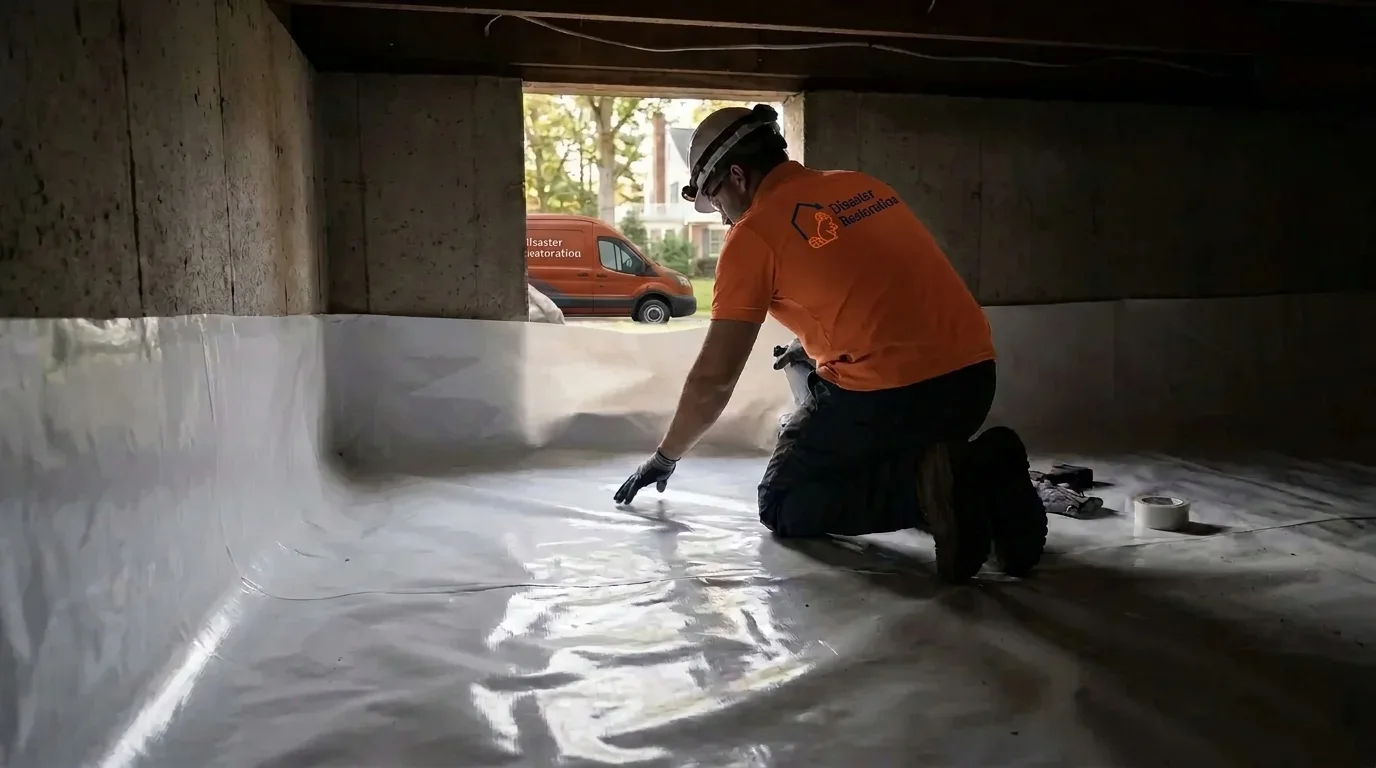
Encapsulation means sealing the crawl space as a controlled environment: a reinforced vapor barrier covers the ground and runs up the foundation walls, seams are sealed, existing vents are closed off, and a dehumidification or conditioned-air system keeps interior humidity in a stable range year-round. This is different from a quick plastic sheet laid over dirt. A proper system addresses the walls, the rim joist, any support piers, and the mechanical penetrations where air actually moves. Jobs typically run one to three days depending on square footage, existing damage, and whether structural wood needs treatment or sistering before the barrier goes down.
Our process
- Crawl space inspection and moisture mapping. We check relative humidity, surface moisture readings on joists and subfloor, standing water or wet soil, existing insulation condition, and signs of past pest or wood-decay activity.
- Site prep and remediation of existing damage. Old insulation, debris, and any deteriorated wood are removed or addressed before encapsulation; a technician holding IICRC WRT and ASD certification oversees moisture readings so we’re not sealing in a problem.
- Vapor barrier installation. A heavy-duty liner is fitted to the ground and foundation walls, seams are taped and mechanically fastened, and penetrations around piers, pipes, and ductwork are sealed.
- Vent sealing and humidity control. Foundation vents are closed and insulated, and a dehumidification unit sized to the space is installed to hold humidity in a stable range through summer condensation season and winter heating season alike.
- Final walkthrough and moisture verification. We re-check humidity and surface readings before closing out the job so you have a documented baseline, not just a visual inspection.
What separates a good crawl space encapsulation from a bad one
The most common shortcut we see is a thin plastic sheet laid loosely over dirt with no wall coverage and no sealed vents, which looks finished but does almost nothing because humid air still moves freely through the space. Another frequent miss is skipping the rim joist, the band of wood that sits right above the foundation wall; it’s one of the most common spots for condensation and rot because it’s exposed to both outside temperature swings and crawl space humidity, and it’s easy to forget because it’s hidden behind the barrier if you don’t seal it first.
A competent job also accounts for what’s already growing before anything gets sealed in. If there’s visible fungal growth on joists or subfloor, that needs to be addressed, not covered, since sealing a crawl space traps whatever conditions already exist inside it. Sizing the dehumidification equipment to the actual cubic footage of the space matters too; an undersized unit runs constantly and still can’t hold humidity down, while a correctly sized system cycles normally and keeps readings stable.
What does crawl space encapsulation cost?
Costs vary with square footage, crawl space height, the condition of existing framing, and whether structural repairs or wood treatment are needed before the barrier goes in. Every job gets a written scope with measurements and material specs before work begins, since no two crawl spaces have identical access, moisture load, or damage history. Homeowners insurance typically does not cover encapsulation as a standalone improvement, though it may help cover related repairs if the moisture damage stems from a covered event like a burst pipe.
| Scenario | Typical range |
|---|---|
| Small crawl space (under 1,000 sq ft), minimal prep | $1,500 - $3,500 |
| Mid-size crawl space with vapor barrier and vent sealing | $3,500 - $7,000 |
| Full encapsulation with dehumidification system | $5,500 - $10,000 |
| Encapsulation plus structural wood repair or sistering | $7,000 - $15,000+ |
| Large or low-clearance crawl space with extensive access work | $10,000 - $18,000 |
Seasonal & regional considerations
Long Island summers bring the humidity that drives most crawl space condensation problems, while winter heating season dries indoor air and can pull moisture up from an unsealed crawl space into living areas above. Nassau County’s older housing stock, much of it built on shallow foundations with stone or block crawl space walls, tends to have more gaps and settling cracks than newer construction, which gives outside moisture and groundwater more paths in. Properties near the Massapequa and East Meadow areas, where water tables run higher, often see standing water or persistently damp soil in crawl spaces even without a plumbing issue.
Service area
We handle crawl space encapsulation throughout Hicksville and surrounding Nassau County communities, including Levittown, Bethpage, Plainview, and Westbury. Housing stock varies block to block in this area, so we scope each crawl space on-site rather than quoting off square footage alone.
If your crawl space smells musty, feels damp underfoot, or you’ve noticed warped flooring above it, get a moisture assessment before it turns into a structural repair. Call (631) 831-1880 to schedule a crawl space inspection and get a written scope for encapsulation.
Frequently Asked Questions
Does homeowners insurance cover crawl space encapsulation?
How do I know if my crawl space needs encapsulation versus just better ventilation?
Will encapsulating my crawl space trap existing mold or rot inside?
Does the crawl space need a dehumidifier after encapsulation, or is the vapor barrier enough?
How long does a typical crawl space encapsulation take?
Looking for the best crawl space encapsulation company in Hicksville?
DISASTER RECOVERY 24/7 SPECIALISTS.COM provides crawl space encapsulation in Hicksville, NY and the surrounding area, and has served local property owners since 2008. Customers rate us 5.0 out of 5 stars across 18 Google reviews. We answer calls 24/7 — call (631) 831-1880 for immediate help.
Need Crawl Space Encapsulation now?
We respond 24/7 across Hicksville and surrounding NY cities.