Commercial Restoration in Hicksville
24/7 commercial restoration in Hicksville and surrounding areas. IICRC-certified technicians, insurance billing accepted. Call (631) 831-1880.
A burst supply line over a weekend at a retail plaza doesn’t wait for Monday. Neither does a kitchen fire at a restaurant that needs to reopen before the next payroll cycle, or a mold colony spreading through HVAC ductwork in a medical office where air quality isn’t optional. Commercial restoration in Hicksville means solving property damage inside buildings that have tenants, inventory, equipment, and revenue on the line, with a different set of pressures than a residential job: code compliance, business interruption, multiple stakeholders, and a clock that’s measured in lost income, not just inconvenience.
What Commercial Restoration actually involves
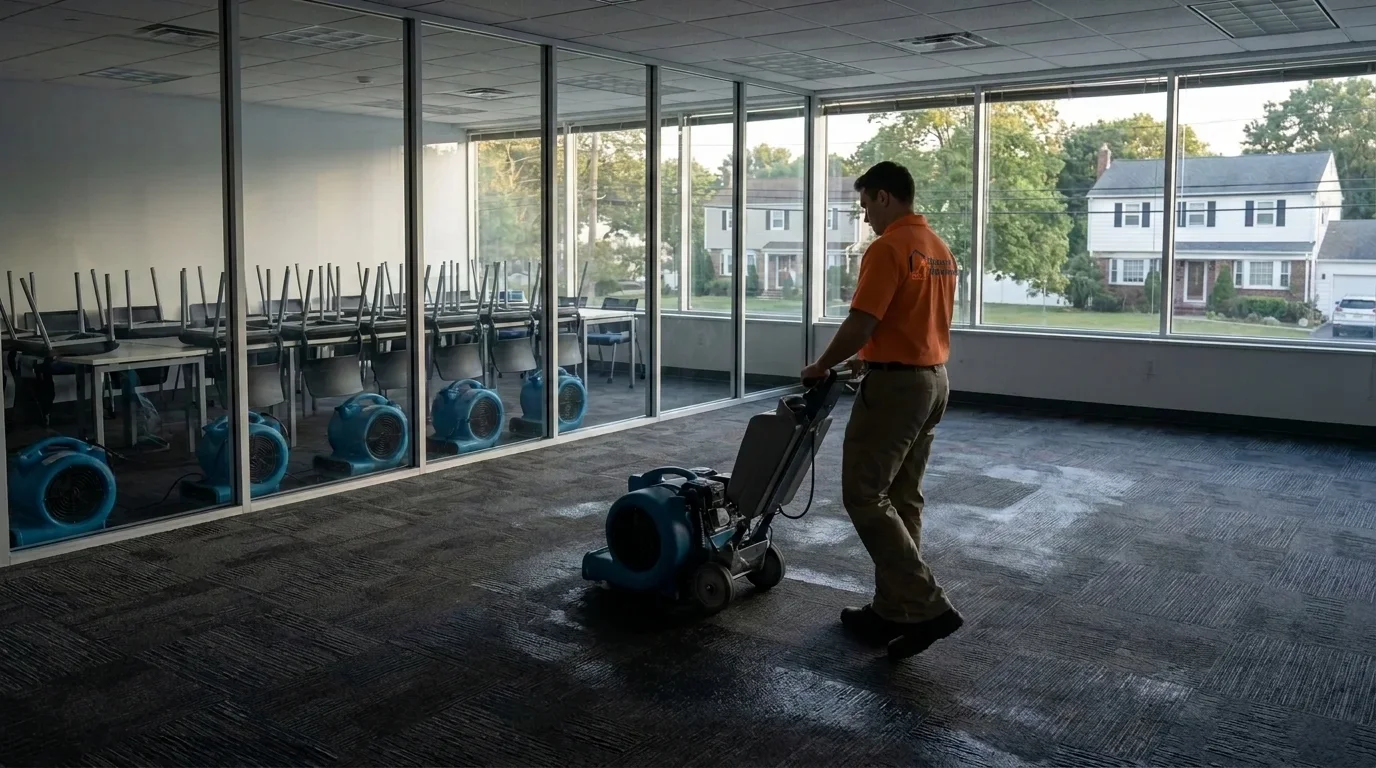
Commercial restoration covers the same categories of damage you’d see in a home, water, fire, smoke, mold, storm, but scaled and sequenced for occupied or operating businesses. That might mean drying a 10,000 square foot warehouse floor with industrial air movers and desiccant dehumidifiers instead of a few household units, coordinating after-hours access with a property manager so a retail tenant doesn’t lose a weekend of sales, or phasing work around a medical or food-service operation that can’t fully shut down. Equipment scales with square footage: more extraction units, more monitoring points, sometimes negative air machines if mold or smoke has moved through shared HVAC. Timelines depend heavily on the building’s construction, a slab-on-grade strip mall behaves very differently than a multi-story office with plenum ceilings, but the goal is always the same: stop the damage from spreading, document everything for the claim, and get the space back to a usable condition with minimal disruption to operations.
Our process
- Site assessment and stakeholder coordination. We walk the affected space with the property manager, business owner, or facilities contact to understand lease boundaries, tenant responsibilities, and any operational constraints before equipment goes in.
- Damage mapping and moisture or soot documentation. Affected materials are measured, photographed, and logged room by room, which becomes the backbone of both our scope of work and the insurance claim.
- Mitigation work by loss type. Extraction and structural drying for water intrusion, soot and odor removal for fire or smoke events, or containment and remediation protocols for mold, each handled by technicians trained in that specific discipline.
- Phased access scheduling. For occupied buildings, work is sequenced around business hours, customer traffic, or critical systems (server rooms, walk-in coolers, production lines) so the business can keep functioning wherever possible.
- Final walkthrough and claim documentation handoff. Once drying logs, moisture readings, or clearance checks confirm the space is restored, we provide a complete record for the insurance carrier and the business’s own files.
What separates a good commercial restoration response from a bad one
The most common mistake on commercial jobs is treating them like oversized residential jobs. A warehouse with a slab floor and open bar joists dries differently than a drywall-and-carpet office suite, and undersizing equipment for the square footage just extends the timeline and the business interruption. Another frequent miss: not accounting for what’s hidden behind commercial-grade construction, rubber base cove, vinyl composition tile over concrete, or metal stud partitions can trap moisture longer than a residential equivalent and read falsely dry on a quick surface check. Adjusters reviewing commercial claims look closely at documented moisture readings over time, not just a single day’s numbers, and they expect a clear equipment placement log tied to square footage. Skipping that documentation is one of the fastest ways a claim gets delayed or underpaid. Good commercial response also means communicating constantly with property management, tenants don’t tolerate surprises, and neither do landlords trying to track multiple units.
What does Commercial Restoration cost?
Commercial losses vary enormously by square footage, construction type, and whether the business needs to stay partially operational during the work, so costs are harder to generalize than a residential job. These figures reflect typical industry ranges for commercial properties, not a quote, and every space is different enough that we provide a written scope of work before any work begins. Commercial property insurance typically covers sudden and accidental damage, business interruption coverage (if carried separately) may also apply, and we document the loss thoroughly to support whichever policies are in play.
| Scenario | Typical range |
|---|---|
| Small office suite, water intrusion | $3,000 - $9,000 |
| Retail space, fire or smoke damage | $8,000 - $30,000 |
| Warehouse floor, large-scale water extraction | $10,000 - $40,000+ |
| Multi-tenant building, shared HVAC mold concern | $6,000 - $25,000 |
| Restaurant or food service, combined water and smoke loss | $12,000 - $45,000 |
Seasonal & regional considerations
Long Island’s older commercial corridors, strip plazas and converted industrial buildings built decades ago often have plumbing and roofing systems that predate current code, which raises the odds of a slow leak going unnoticed inside a wall or above a drop ceiling. Winter freeze-thaw cycles put added strain on exposed pipe runs in unheated storage areas and loading docks, while summer humidity creates faster mold growth windows in buildings with HVAC systems that aren’t sized for Nassau County’s muggier stretches. Flat commercial roofs common in strip malls and office parks are also more prone to ponding and slow leaks than residential pitched roofs, which is worth factoring into any preventive maintenance conversation with a property manager.
Service area
Based in Hicksville, we handle commercial restoration work throughout Nassau County and the surrounding Long Island communities, including office parks, retail plazas, warehouses, and multi-tenant buildings across the region.
If your business is dealing with water, fire, smoke, or mold damage and needs a scope of work that accounts for tenants, operations, and insurance documentation, call (631) 831-1880 to get a commercial restoration assessment started.
Frequently Asked Questions
Does commercial property insurance cover restoration work like this?
Can a business stay open during commercial restoration work?
How is equipment sized for a large commercial space compared to a home?
What documentation does my property manager or insurance adjuster need from a commercial loss?
Do different parts of a commercial building need different restoration approaches?
Looking for the best commercial restoration company in Hicksville?
DISASTER RECOVERY 24/7 SPECIALISTS.COM provides commercial restoration in Hicksville, NY and the surrounding area, and has served local property owners since 2008. Customers rate us 5.0 out of 5 stars across 18 Google reviews. We answer calls 24/7 — call (631) 831-1880 for immediate help.
Need Commercial Restoration now?
We respond 24/7 across Hicksville and surrounding NY cities.