If a pipe just split in your Hicksville cape or your finished basement took on water after a heavy rain, the number you actually need is a range you can plan around, not a guess. In Nassau County, water damage restoration typically runs from about $1,500 for a single-room clean-water leak to $40,000 or more for a flooded, finished basement that needs full structural drying and rebuild. Where your job lands in that range depends on the category of water, how many square feet got wet, how many days of drying it takes, and whether reconstruction is needed on top of mitigation.
How Much Does Water Damage Restoration Cost in Hicksville, NY?
Most Hicksville water damage jobs fall between $3 and $8 per square foot for mitigation alone, with the total job cost shaped by how contaminated the water is and how much rebuild follows. A small, clean-water leak caught fast might close out under $2,000. A flooded finished basement with soaked carpet pad, wet drywall, and a waterlogged subfloor can run well into five figures once drying, demolition, and rebuild are all added together.
Here’s a realistic range by scenario, based on typical industry pricing for this type of work:
| Scenario | Typical Cost Range |
|---|---|
| Single room, Category 1 clean water (supply line, appliance leak) | $1,500 - $3,500 |
| Multiple rooms, Category 1 or 2 water | $3,500 - $7,500 |
| Category 2 (gray water) damage affecting a finished basement | $5,000 - $12,000 |
| Category 3 (black water or sewage backup) cleanup | $7,000 - $15,000+ |
| Mitigation plus reconstruction (drywall, flooring, trim, paint) | $10,000 - $30,000+ |
| Whole-basement flood with structural drying and full rebuild | $15,000 - $40,000+ |
These are typical ranges, not quotes. Every loss is different, and a written scope of work after an in-person assessment is the only reliable number for your specific job.
What Drives the Price: Category of Water, Square Footage, Drying Days, and Rebuild?
Four factors move the price more than anything else: how contaminated the water is, how many square feet it reached, how many days of drying equipment the job needs, and whether reconstruction follows mitigation. Get a handle on these four and you understand your estimate.
Category of water. The ANSI/IICRC S500 standard splits water losses into three categories. Category 1 is clean water from a supply line or appliance. Category 2, also called gray water, carries some contamination, think washing machine discharge or a sump pump backup. Category 3, or black water, includes sewage backups and floodwater that’s been sitting, and it requires more aggressive demolition of porous materials like carpet pad and drywall. Category 3 jobs cost more per square foot because more material has to come out, not because the labor is harder.
Affected square footage. Water spreads along baseboards and under flooring faster than it shows on the surface, so a tech typically maps the true wet area with a moisture meter before pricing. A 200-square-foot kitchen leak prices very differently than a 1,200-square-foot finished basement.
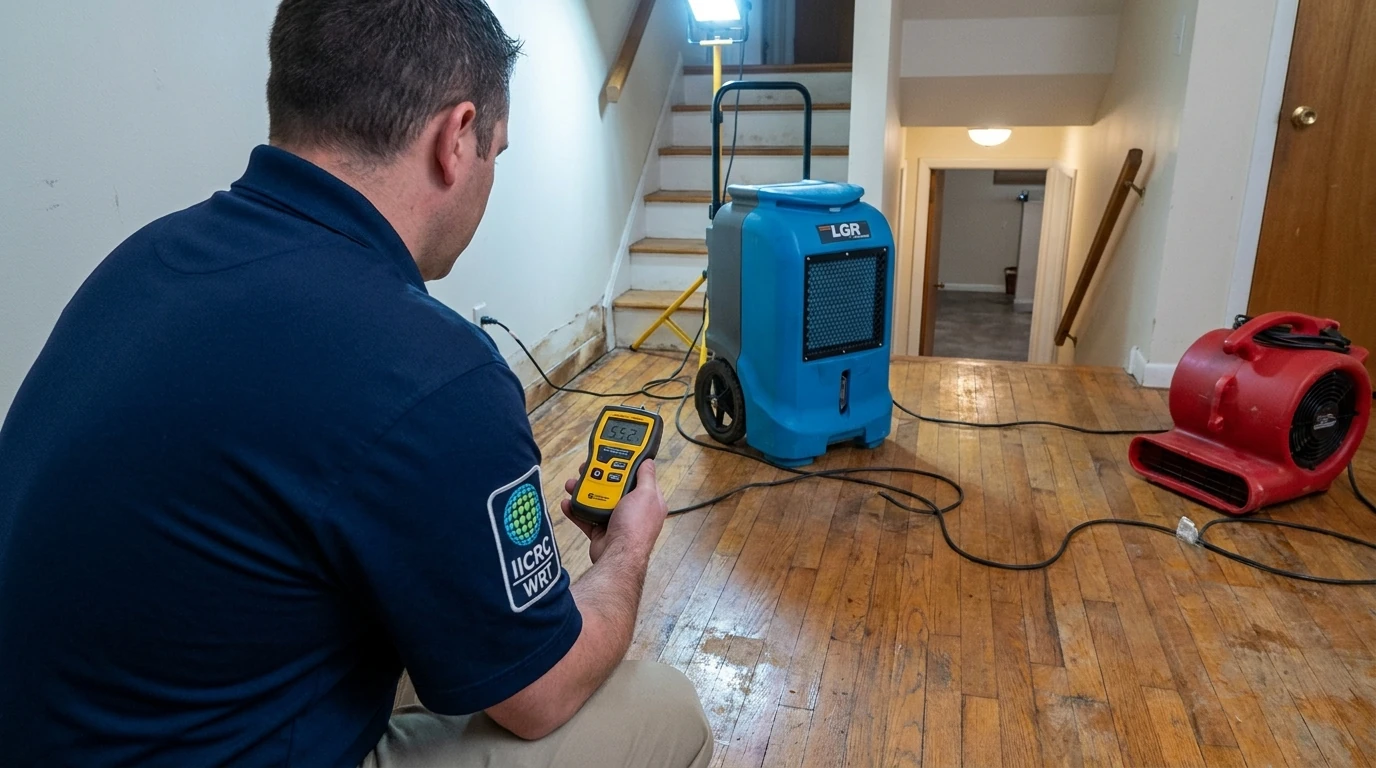
Drying days. Structural drying with air movers and low-grain-refrigerant (LGR) dehumidifiers usually runs 3 to 5 days for a standard residential loss, monitored daily with moisture readings until the materials hit a dry standard. More affected square footage, denser building materials like plaster, or a slow-to-dry Hicksville basement can push that to 5-7 days. Every extra drying day adds equipment rental and monitoring visits to the invoice.
Mitigation versus reconstruction. Mitigation is the extraction, drying, and antimicrobial treatment that stops the damage from getting worse. Reconstruction is the rebuild: new drywall, flooring, trim, cabinetry, and paint. These are billed and scoped separately, even when the same contractor handles both. A job that’s “just drying” costs a fraction of one that also needs a rebuilt basement.
How Long Does Water Damage Restoration Take in Hicksville?
A typical residential water damage job in Hicksville takes 1 to 2 weeks from first call to final walkthrough, with most of that time spent drying rather than rebuilding. Extraction and setup usually happen the same day or the next. Structural drying runs 3-5 days for a standard loss. If reconstruction follows, add another 1-3 weeks depending on how much demolition and rebuild the job needs.
Older Hicksville housing stock adds a wrinkle. Many post-war capes and ranches here have finished basements with limited sub-slab drainage and a Long Island water table that sits higher than homeowners expect. A basement that floods once tends to hold moisture in the framing and subfloor longer than a newer build, which can stretch drying time past the typical range if monitoring readings aren’t hitting dry targets yet.
Does Homeowners Insurance Cover Water Damage in New York?
Most New York homeowners policies cover water damage that is sudden and accidental, like a burst pipe or a failed water heater, but they generally exclude gradual leaks and damage from flooding. The distinction matters because it determines whether your mitigation and rebuild costs are reimbursed at all.
Sudden pipe failures, appliance line ruptures, and similar one-time events are typically covered perils under a standard NY homeowners policy, subject to your deductible. A slow leak behind a wall that went unnoticed for months is usually treated as a maintenance issue and denied. And flooding from rising groundwater or overland water, the kind some Nassau County basements see after heavy storms, is excluded from standard homeowners policies entirely; that coverage requires a separate flood policy through the National Flood Insurance Program. For a deeper breakdown of what’s typically covered and what isn’t, see our guide on whether homeowners insurance covers water damage. You can also check New York’s own consumer guidance through the NY Department of Financial Services.
Documentation drives the claim outcome more than almost anything else. Photos of the source of the leak, moisture readings taken at intake, and a dated scope of work give an adjuster what they need to approve mitigation quickly instead of questioning it.
What Happens During Water Damage Restoration?
- Assessment and moisture mapping. A technician inspects the affected area, identifies the water category, and maps the true extent of moisture intrusion with a meter, not just what’s visible.
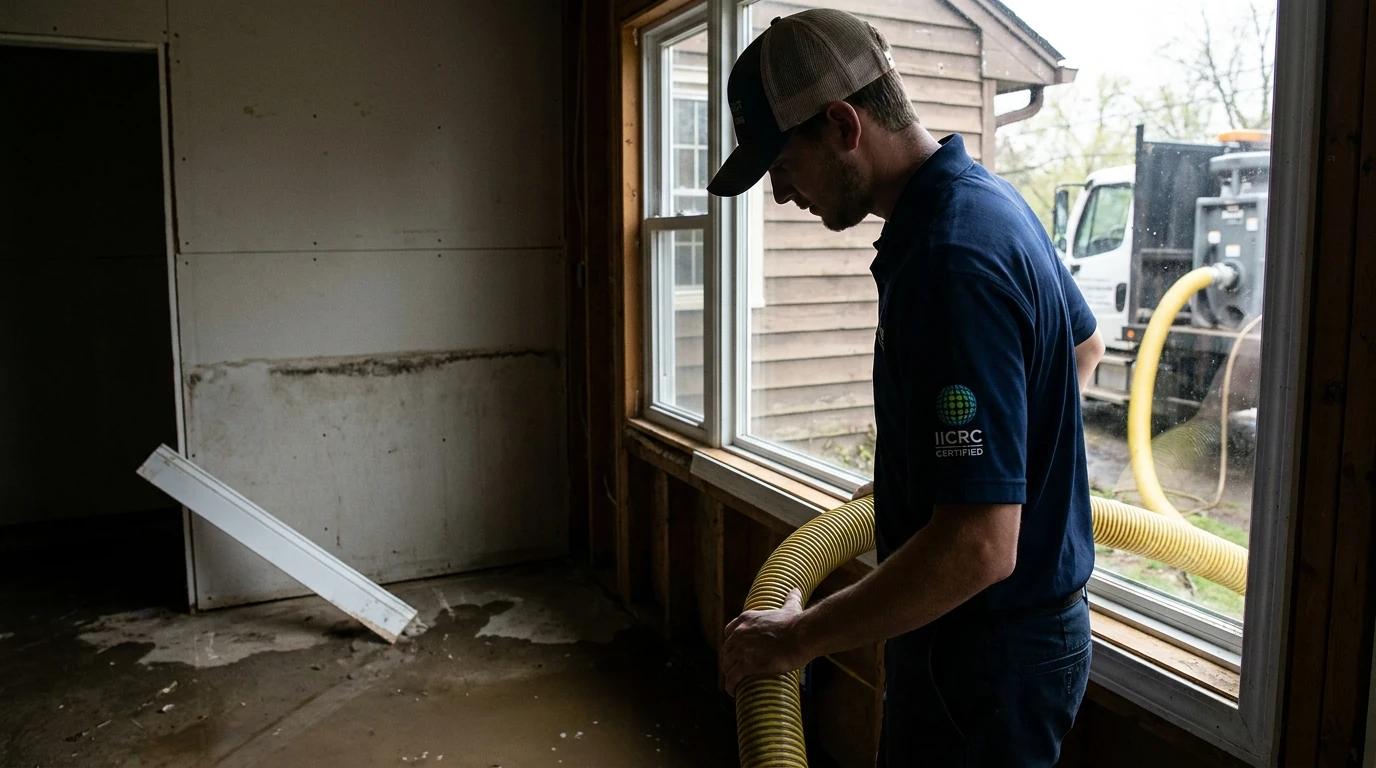
- Extraction. Standing water is removed with truck-mounted or portable extraction equipment before drying equipment goes in.
- Structural drying. Air movers and LGR dehumidifiers are placed and monitored daily until wet materials reach a dry standard, typically 3-5 days for a standard residential loss.
- Antimicrobial treatment. Affected surfaces are treated to address bacteria and limit mold risk, especially on Category 2 and 3 losses.
- Reconstruction. If drywall, flooring, or trim were removed, the rebuild phase replaces them to match the original space, scoped and priced separately from mitigation.
- Final walkthrough. Moisture readings are confirmed dry, and the completed scope is documented for the homeowner and the insurance file.
Who Should You Call for Water Damage Restoration in Hicksville?
Start with a company that handles both mitigation and reconstruction under one roof so the drying phase and the rebuild phase are coordinated instead of handed off between two contractors. DISASTER RECOVERY 24/7 SPECIALISTS.COM employs IICRC-certified technicians serving Hicksville and the surrounding Nassau County towns, and can walk a flooded basement or a fresh pipe failure through assessment, drying, and rebuild with one written scope of work.
Getting a written scope before work begins is the single best protection you have, both for your budget and for your insurance claim. It turns a vague worry about cost into a specific, documented number you and your adjuster can both work from.
About DISASTER RECOVERY 24/7 SPECIALISTS.COM
DISASTER RECOVERY 24/7 SPECIALISTS.COM employs IICRC-certified technicians serving Hicksville, NY and nearby Nassau County communities including Hempstead, Levittown, Freeport, Plainview, and Massapequa since 2008. The team holds IICRC certifications in water restoration (WRT), structural drying (ASD), fire and smoke (FSRT), and mold remediation (AMRT), and offers 24/7 emergency response. Their work covers water damage restoration, reconstruction, mold remediation, fire and smoke damage restoration, sewage cleanup, and related general contracting services across the region.